
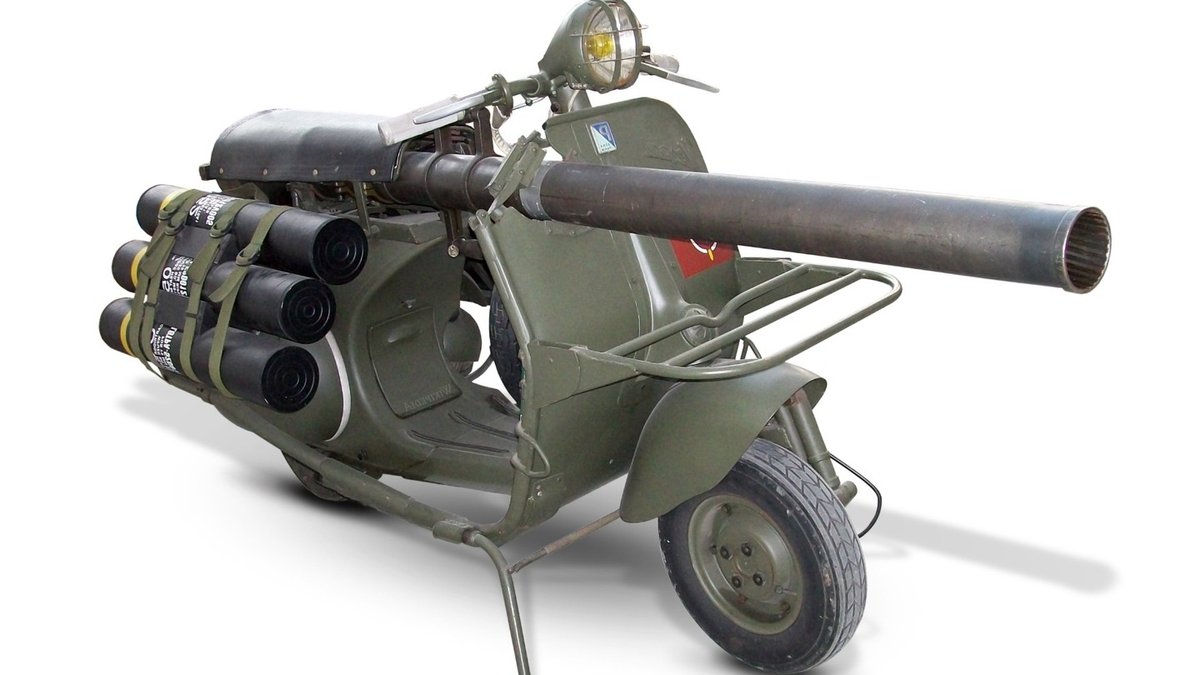
The French Army tapped Vespa to create a tiny tactical war machine for its paratroopers during the First Indochina War. Vespa’s reputation for rugged and dependable vehicles made it an ideal choice for the French Military, which needed a small, lightweight vehicle for traveling through the jungle with considerable firepower.
The Italian-based company designed the Vespa 150 TAP, with “TAP” standing for “Truppe Aero Portate” or airborne troops. The Vespa 150 TAP was produced at Piaggio’s French factory, Ateliers de Construction de Motocycles et d’Automobiles (ACMA), and was based on the 150 VL3 scooter.
Design and Production
The Vespa 150 TAP had a new 150cc square engine, which replaced the VL3’s problematic 150cc rectangular engine. This engine had a smaller bore and slightly longer pistons, reducing the rattle and allowing for better fuel consumption, with a range of up to 124 miles.
The TAP 150 began production at ACMA a year before it started building Vespa’s 400 automobile. The Vespa 150 TAP was available in either a camouflage sand or green color, and its base was the 150 VL3 scooter.
Modifications and Capabilities
The most notable alteration from the standard 150 Vespa VL3 was the installation of a large American M20 recoilless cannon, positioned centrally beneath the seat and integrated into the front fairing. These weapons were never intended to be discharged while the scooter was moving, as doing so would likely prove fatal.
Read Also: Australia’s vintage racing cars face tobacco livery ban
To manage the added mass, the scooter received extra strengthening along its lower chassis, featuring rubber-coated supports that helped cushion impacts when it landed. The concept called for these compact anti-tank Vespas to be airdropped alongside French paratroopers, deployed in pairs.
One of the pair would transport the heavy gun together with its driver, while the second scooter would haul essential supplies such as spare fuel, ammunition and a loader, with some configurations even adding a small single-wheel trailer. The 150 TAP model was built solely to bear the gun, which would be taken off the vehicle and set up for firing on enemy forces.
Deployment and Legacy
By the time Piaggio began fabricating these miniature tank-like machines, the First Indochina conflict had already concluded. The 150 TAPs entered service in 1956, being sent to Algeria for use by French forces in the ongoing war there. During this period two variants were fielded: the original TAP 56 and the later TAP 59.
Production of the 150 TAP ceased in 1959 after roughly 600 units had been built. The concept never gained wide acceptance, leaving the company’s wartime scooter line empty. Occasionally an original TAP surfaces on the collector market, where it typically commands prices between about $33,000 and $46,000 USD.


