
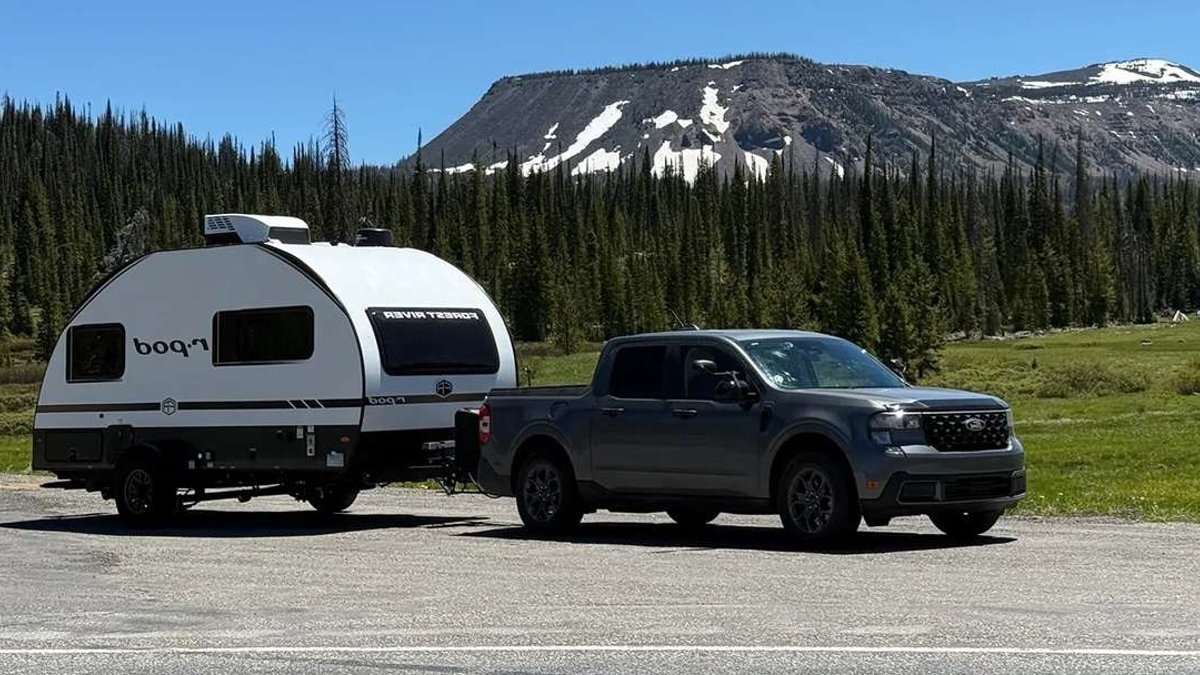
A 2025 Ford Maverick XLT towed a 3,200-pound camper across 6,500 miles of Western terrain, including mountain passes and national parks, encountering only one major difficulty: Wyoming’s crosswinds. The vehicle’s 2.0-liter EcoBoost engine, combined with Ford’s 4K Tow Package, managed steep grades and high-altitude routes without complications, according to a trip report from a Michigan-based driver known as Patriot68 on the MaverickTruckClub forum.
The Route: Yellowstone to the Badlands and Beyond
The five-week expedition traversed Yellowstone National Park, the Teton Mountains, Mount Rushmore, and the Badlands, crossing the Continental Divide multiple times. A photograph from the journey shows the gray Maverick and white R-Pod 171 camper parked beside Togwotee Pass at 9,567 feet elevation, with the camper’s rooftop air conditioner extending above the truck against a backdrop of rocky peaks and pine trees.
Patriot68 observed that the truck handled sustained 7%+ grades in both uphill and downhill directions without hesitation. The 4K Tow Package proved essential: Ford’s 2025 towing guide specifies its use for trailers exceeding 2,000 pounds, granting the EcoBoost AWD Maverick a 4,000-pound maximum loaded trailer capacity. The R-Pod’s 3,200-pound weight—800 pounds below the limit—allowed the truck to operate comfortably within its designated range.
Key Features of the 4K Tow Package
The 4K Tow Package incorporates a transmission oil cooler, a higher-capacity radiator, an upgraded cooling fan, and an integrated trailer brake controller. Ford’s owner’s manual outlines the truck’s towing modes, which include settings to delay upshifts and activate engine braking for better downhill control. The system defaults to Normal upon restart but retains the last selected mode for convenience.
The brake controller requires a seven-pin connector rather than the standard four-pin setup, meaning owners must verify compatibility with their trailer’s braking system. Patriot68 did not disclose tongue weight measurements, though Ford’s guidelines set a maximum of 400 pounds. The truck’s payload and axle limits remain applicable regardless of the tow package installation.
Related Post: Ford EV Truck to Feature Apple Maps
Fuel efficiency fluctuated between 15–16 miles per gallon while towing in mountainous regions and 18–19 miles per gallon on highway segments between Michigan and Nebraska. The report does not specify cruising speeds or whether the figures originated from the dashboard or manual calculations.
The only notable challenge arose in Wyoming, where 40–50 mph crosswinds near Cheyenne triggered highway closures. A camper’s broadside profile makes it susceptible to gusts, even when operating within tow ratings. Wyoming’s transportation officials advise recreational travelers to monitor road conditions and anticipate delays during wind events.
Patriot68 concluded with a straightforward assessment: Extremely happy. The journey delivered scenic national park views, mountain passes, and a truck that performed as advertised, with the exception of Wyoming’s wind conditions.
Performance Under Testing Conditions
The Maverick’s ability to handle grades and high-altitude routes demonstrates its towing technology can meet real-world demands, though Wyoming’s winds highlighted a persistent vulnerability: crosswind stability. Smaller trucks towing trailers frequently appear in wind-related advisories, yet the Maverick’s handling remained impressive despite the 9,567-foot elevations and steep descents. The 4K package’s cooling and braking enhancements likely prevented overheating or brake failure, but the winds proved unpredictable.
Towing Mode Functionality and Compatibility Requirements
The 2025 Maverick’s Tow/Haul mode adjusts transmission behavior to minimize gear shifts and engages engine braking for better speed management on descents. After a restart, the truck reverts to Normal mode but allows users to recover the previously selected setting if confirmed. The system recommends recalibrating controls when conditions like load, road surfaces, or weather change to avoid trailer wheel lockup.


