
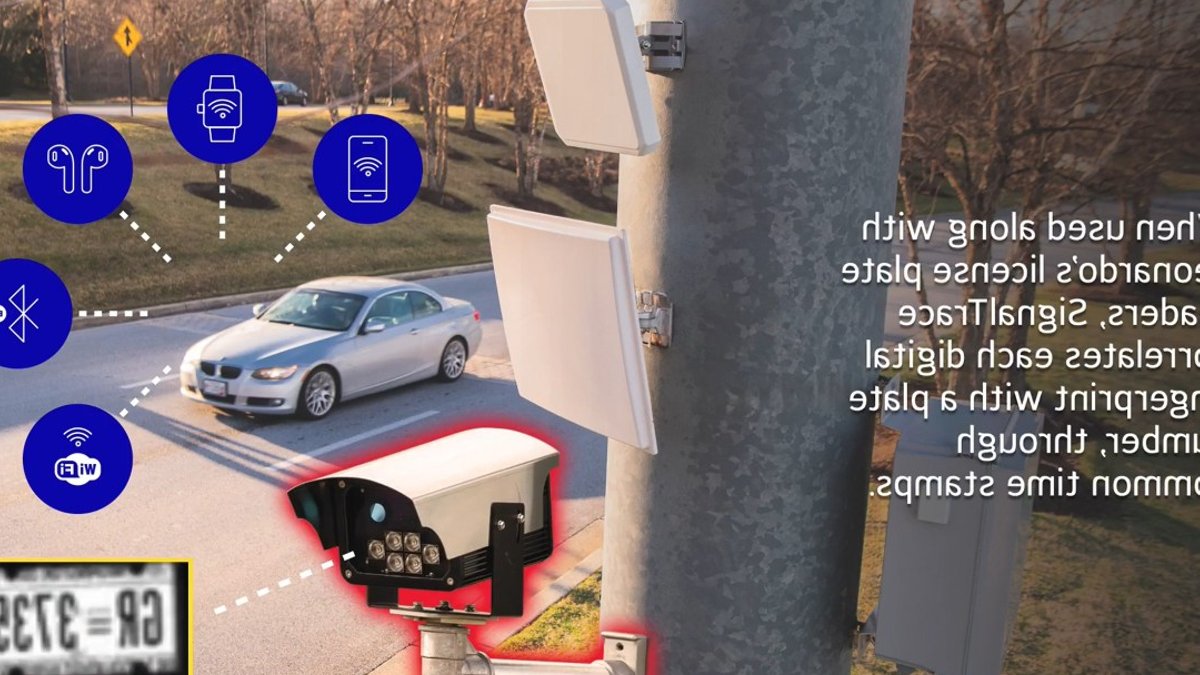
Automatic license plate readers have faced criticism for tracking vehicles without warrants. Companies like Flock and Leonardo now say their systems can link license plates to wireless signals from phones, tire pressure sensors, and pet microchips. A security researcher’s findings suggest those claims may be exaggerated.
Leonardo’s SignalTrace, a newer product, pairs with ALPRs to correlate license plates with Bluetooth, Wi-Fi, and other wireless signals. The company claims it can detect tire pressure monitoring sensors and pet microchips. Ryan O’Horo, an offsec engineer and security consultant, discovered that real-world deployments remain rare. Only a few exist in Oxon Hill, Maryland, installed by the Prince George’s County Police Department.
O’Horo’s work reveals differences between Leonardo’s marketing and actual performance. Most electronics do not broadcast identifiable data continuously. SignalTrace would need to capture a device at the right moment to gather useful information. Wireless signals also operate across multiple channels, making it hard for a single radio to monitor all of them simultaneously.
The product uses off-the-shelf components, which restricts its capabilities. Flat-panel antennas, for instance, cannot pick up frequencies used by most tire pressure sensors. Pet microchips rely on RFID at very low frequencies and require close proximity—something a traffic camera cannot achieve. O’Horo believes the marketing may refer to Wi-Fi or Bluetooth-enabled pet collars rather than the microchips themselves.
Wi-Fi and Bluetooth signals pose the greatest tracking risk. These signals work over long distances and remain active. Some Flock cameras already scan for Wi-Fi and Bluetooth, so the infrastructure for this surveillance exists.
Related: Dodge markets new Charger without V8 engine
O’Horo points out limitations even here. A single pass by a sensor might miss some signals. Multiple scans or collection points would be needed to build a reliable profile. The threat remains real, though the technology is not as powerful as companies suggest.
The main concern for most people is not pet microchips or tire sensors. Smartphones are far easier to track. Wi-Fi and Bluetooth signals from phones create a digital trail. ALPRs already map vehicle movements. Adding wireless signal correlation could make it harder to move through public spaces unnoticed.
The most alarming claims, like tracking microchips, are unlikely. But Wi-Fi and Bluetooth scanning already raises privacy concerns. The gap between marketing and reality does not make the technology safe. It means the real risks are more common—and harder to ignore.
O’Horo published a detailed technical breakdown on his blog. The main point is clear: these systems do not need to be all-seeing to cause problems. Wireless signals from vehicles and devices create enough data to raise concerns without exaggerated claims.


