
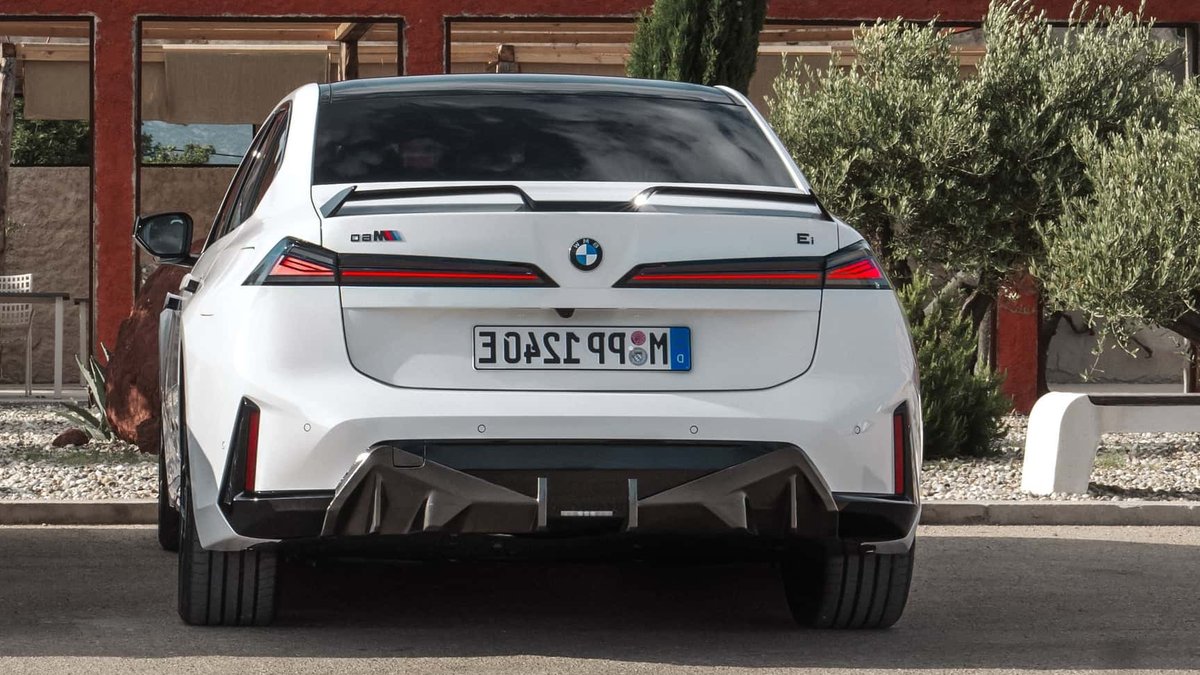
BMW has moved past its earlier rejection of simulated gear shifts in electric vehicles, now adopting the technology it once labeled a “funny gimmick.” The feature will debut next year on the already-revealed i3 M60 xDrive, giving the electric sports sedan another trick to make driving more engaging. Rather than calling them gears, BMW refers to the simulated shifts as “Stages.” We actually saw this coming when BMW released official images of the i3 M60 at the end of September. Although the M division stayed tight-lipped about the technical specifications, one interior photo showed red-accented shift paddles behind the steering wheel.
This change stems from a reassessment of engineering priorities. Christian Heiss, BMW‘s senior road manners engineer, had previously dismissed the concept when Hyundai introduced it on the Ioniq 5 N. However, after evaluating the Ioniq 5 N and other performance EVs, BMW recognized potential benefits. “We’d seen it before – for example, the Hyundai,” Heiss told Carsales during the international launch of the new 3 Series and i3. “We at BMW thought: well, that’s a funny gimmick.
We’re in an electric world; why copy things out of the combustion engine?” The company’s testing revealed that simulated gear changes offered more than just nostalgic appeal, particularly in terms of drivability and driver feedback, especially on track. Alexander Karajlovic, head of BMW M development, explained in an interview with PistonHeads that artificial ratios help drivers better judge their speed when approaching corners, providing useful feedback that electric vehicles otherwise lack.
BMW’s full-power ‘Stages’ outpace rivals
The system differs from Hyundai’s N e-Shift, which restricts torque based on simulated ratios. BMW’s approach maintains full power output across all “Stages,” ensuring no performance loss. This aligns with the company’s goal of preserving traditional gearbox feedback while eliminating mechanical complexity. Heiss emphasized that BMW’s solution is “We’ve ended up with something close to a gearbox simulation, but we don’t call it a gearbox simulation.
It’s thought out differently,” ensuring drivers experience engagement without artificial performance limitations. The dual-motor configuration produces 603 horsepower and 645 lb-ft of torque, potentially surpassing its SUV counterpart, the iX3 M60, which accelerates to 62 mph in 3.9 seconds. The sedan’s aerodynamic shape could also translate into better electric range than the iX3 M60’s 468-mile WLTP-rated range, with BMW quoting a top speed of 149 mph (240 km/h) for the high-riding model.
M-only feature joins EV performance arms race
The i3 M60 xDrive will incorporate an artificial soundtrack to accompany its simulated shifts. Though BMW has not disclosed the exact number of “Stages,” the sedan’s dual-motor configuration ensures high performance across all settings. The feature will remain limited to M Performance models, starting with the M60. Heiss confirmed the feature’s exclusivity to this segment, with the full-fat electric M3, expected in 2027, likely adopting it as well due to its quad-motor setup.
BMW once thought simulated gear changes were a funny gimmick, but now it’s joining the party. Hyundai might deserve a thank-you note, and not just from Munich. Porsche offers simulated gear changes in the Taycan, while Mercedes-AMG has a similar feature in its GT 4-Door Coupe. Both also pump artificial engine sounds through the speakers. It’s a brave new world out there.


