
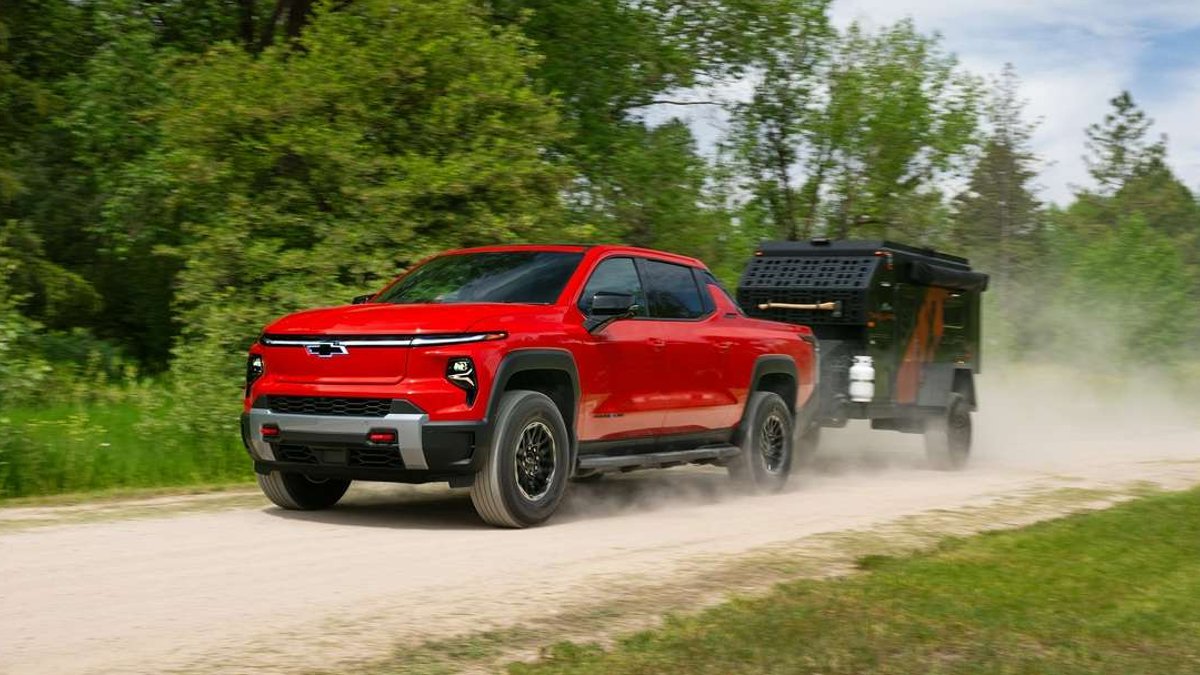
The driver of a Chevrolet Silverado EV reports paying roughly $88 to charge the vehicle during his 3,500-plus miles, which is about one-fourth of the diesel fuel expense he logged for his former Volkswagen Passat. The perk was home charging, with overnight electricity at 5.3 cents per kilowatt-hour.
Dustin Paulson, posting as dustinp on the Unofficial Camp-Inn Forum, had a fuel-efficient vehicle to compare with his new Chevrolet. Previously, he reported his Volkswagen achieved 51 MPG on a 600-plus-mile round trip to collect the EV, and later he calculated the Chevrolet’s charging cost at around 2.5 cents per mile.
Paulson’s report of his ownership experience included a total charging cost of $88 before making public fast-charging stops on the Oshkosh trip. He also used an RV hookup at a houseboat operator’s location but didn’t provide details on this charge or how it was factored into the total cost, and no billing records were shared.
Diesel Fuel Cost Comparison
The Diesel Comparison Works Out to $350
To calculate the diesel cost, assuming 50 MPG without a trailer and a diesel price of $5 per gallon, the Volkswagen would need 70 gallons for 3,500 miles, totaling $350 or 10 cents per mile. In contrast, Paulson’s $88 charging cost for 3,500 miles works out to about 2.5 cents per mile, showing a significant difference of roughly $262.
The $262 difference only accounts for energy expenses, excluding costs like purchasing the truck, installing a charger, insurance, and depreciation, which are separate financial considerations.
Even with diesel at $3 per gallon, a 50-MPG Volkswagen would spend $210 on fuel over 3,500 miles, compared to Paulson’s reported $88 for the Chevrolet, demonstrating the electric vehicle’s cost advantage, although lower fuel prices reduce this gap.
Cheap Overnight Electricity Conditions
Cheap Overnight Electricity Comes With Conditions
Paulson does not name his utility, but a 5.3-cent EV rate is available in Minnesota. East Central Energy’s residential rate sheet lists that price for its storage-EV program, plus a $3 monthly meter charge.
Its EV program brochure calls for an additional meter and a hardwired charger, with power supplied only during off-peak hours. That arrangement suits a truck parked at home overnight. Charging hours, monthly fees, and installation costs all belong beside the energy rate when comparing plans.
Related Post: Car and Driver Names Top Electric Vehicle
Towing and Campground Charging
He Towed 277 Miles, Then Charged for the Campground
Paulson also put his Silverado EV Max Range to work pulling a Camp-Inn 550 teardrop. Starting at 100% charge, he reported covering 277 miles from home to Plover, Wisconsin, and arriving with 25% remaining. For that Oshkosh trip, he chose non-freeway roads with 55-65 MPH limits.
A 25-minute charging stop brought the battery to 80% while he used the restroom and grabbed food. He wanted enough energy at camp to power the trailer and a freezer, so the stop served more than the drive’s remaining 70 miles. The 550 is a compact camper: Camp-Inn’s current specifications list approximate weights of 850-1,240 pounds for the standard model, depending on options. Those are manufacturer figures, not a measured loaded weight for Paulson’s trailer. His trip describes towing a small teardrop at moderate speeds.
His Next Trip: Let the Truck Charge While He Camped
Paulson wrote that “it went even better than the first.” His later camping update describes a stop in Tomah to leave a fallback charging option, followed by charging at camp. His portable GM charger initially shut down; he said it worked after he resolved a startup mistake. Over three nights, the truck recharged slowly to 100% just before departure. At checkout, Paulson volunteered a payment of about twice what the added electricity would have cost him at home. Staff accepted, he wrote; he did not give the amount.
He reported reaching home after 278 miles with 25% charge remaining, almost the same distance and arrival charge as his earlier leg to Plover.
This time, the truck could recharge while he camped. To plan a similar stay, ask the campground whether EV charging is permitted, what connection is available, and what it costs.
Electricity Rates vs. Fuel Costs
The Rate That Can Erase the Fuel-Cost Advantage
For a price comparison, assume a truck travels 2 miles per kWh purchased, including charging losses. That is an illustration, not Paulson’s measured efficiency. At 5.3 cents per kWh, energy costs about 2.7 cents per mile. At 20 cents, it costs 10 cents per mile, matching the 50-MPG diesel at $5 per gallon. At 50 cents, it costs 25 cents per mile.
Charging Expense Analysis
To calculate per-mile charging costs, Paulson added all electricity expenses, session charges, and monthly fees, then divided by miles driven with matching battery levels. His home charging at 5.3 cents per kWh included a $3 monthly meter fee, contributing to the $88 total for 3,500 miles. He separated home and travel costs, noting complimentary RV hookup charging reduced his out-of-pocket expenses.


