
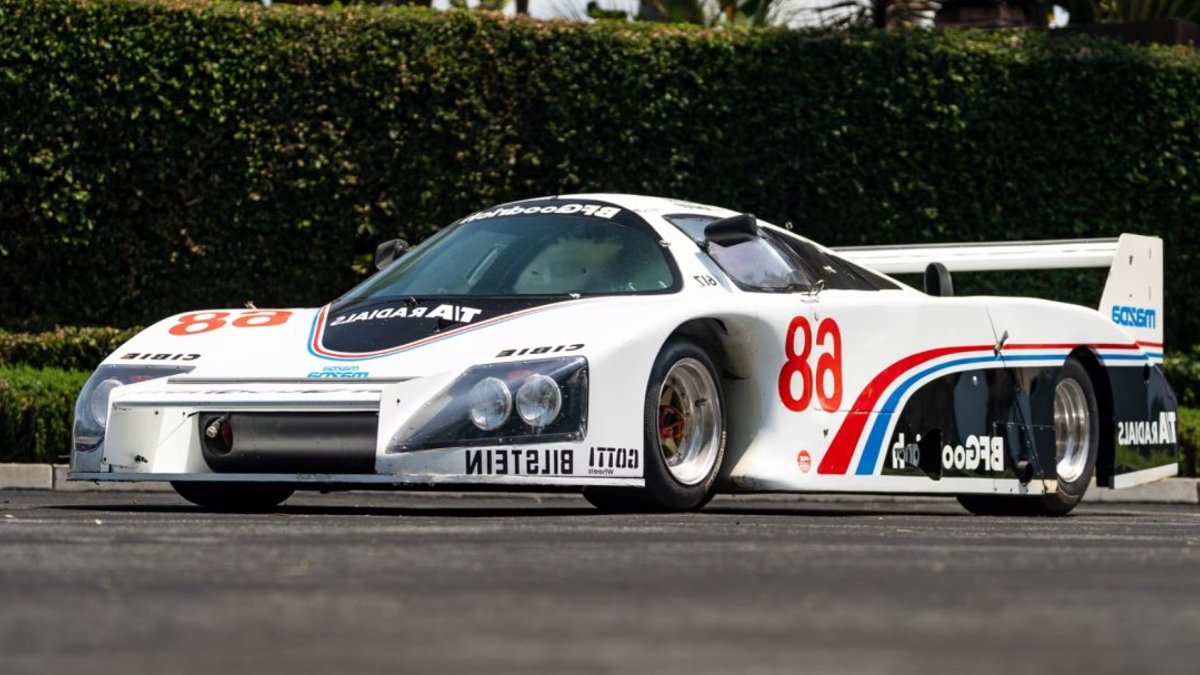
For sale at Mecum’s 2026 Monterey Car Week auction is a 1984 Lola T616 that won its class at the 24 Hours of Le Mans on street tires. The car, chassis HU-2, achieved the C2-class victory at the 1984 event while wearing promotional BFGoodrich radials, a feat that helped cement a unique connection between road relevance and endurance racing. The marketing gamble produced an unlikely result.
Winning on Sunday
It usually takes showroom models or homologation specials to connect road cars and race cars, but 40 years ago BFGoodrich used endurance racing to promote its T/A radials. The company fielded a two-car team in both the IMSA GT Championship and the FIA World Endurance Championship, including the prestigious 24 Hours of Le Mans. At Le Mans, chassis HU-2 scored a class win on the very street tires the team was built to promote.
Team BFG’s class win was the second in a row for a Mazda rotary-powered car, helping build momentum for the manufacturer’s overall Le Mans win with the 787B in 1991. The cars are expected to sell for around $300,000, which is about $100,000 more than its sibling chassis, HU-3. The 1984 campaign included major IMSA races like Sebring and Daytona, where the Lola team ran street tires on the track’s high banking, making them the first cars to do so.
An Unlikely Combination
Chuck Patrick, then a BFG tire engineer, said in a 2005 Vintage Motorsport article that the problem was nobody really cared about any RX-7 doing well. Marketing asked how to demonstrate the company was making a fine product, and the solution was stepping up to the FIA C2 class, the second-tier for prototypes. The team contracted driver Jim Busby to run the Lola T616 chassis, which was paired with a 1.3-liter 13B rotary engine from the RX-7.
According to drivers quoted in that article, the tires were less of a factor than the engine, which was both less powerful and less fuel-efficient than most of the competition (with the exception of the factory Mazda 727Cs also running that year). The T616 had to be driven conservatively to save fuel, and the chassis was designed for a heavier, more powerful engine, both of which might have helped mask any differences in performance between its street tires and the purpose-built racing rubber on other cars.
Related: Test Driver’s Utopia Roadster Ride Leaves Lasting Impact
While the all-important street tires retained the same overall design as the retail versions, they had to be reshaped for the 13×11-inch front and 13×14-inch rear wheels demanded by the regulations. A 3,000-mile testing program ensured they were ready for the season. The second car, driven by Busby, Rick Knoop, and Boy Hayje, came home third in class and 12th overall at Le Mans, with the first car finishing 10th overall.
From the Garage to the Track
It’s also surprising that both cars still exist to tell that tale. They aren’t exactly as well known as period Group C cars like the Porsche 956, after all. Thankfully, Busby and Knoop acquired and restored the pair in the early 2000s. They’ve been making regular appearances in vintage racing ever since, a story that won’t be repeated in today’s more restrictive environment.
Despite the lack of commercial success for the tires, the marketing gamble produced an unlikely result. The cars represent a specific moment in time when a tire company could essentially build a factory team to prove a point, using a relatively small budget to secure a podium finish at the world’s most famous endurance race. This unique approach demonstrates the value of endurance racing for manufacturers.
Chuck Patrick, a former CAT engineer, likely appreciated the engineering challenge.


