
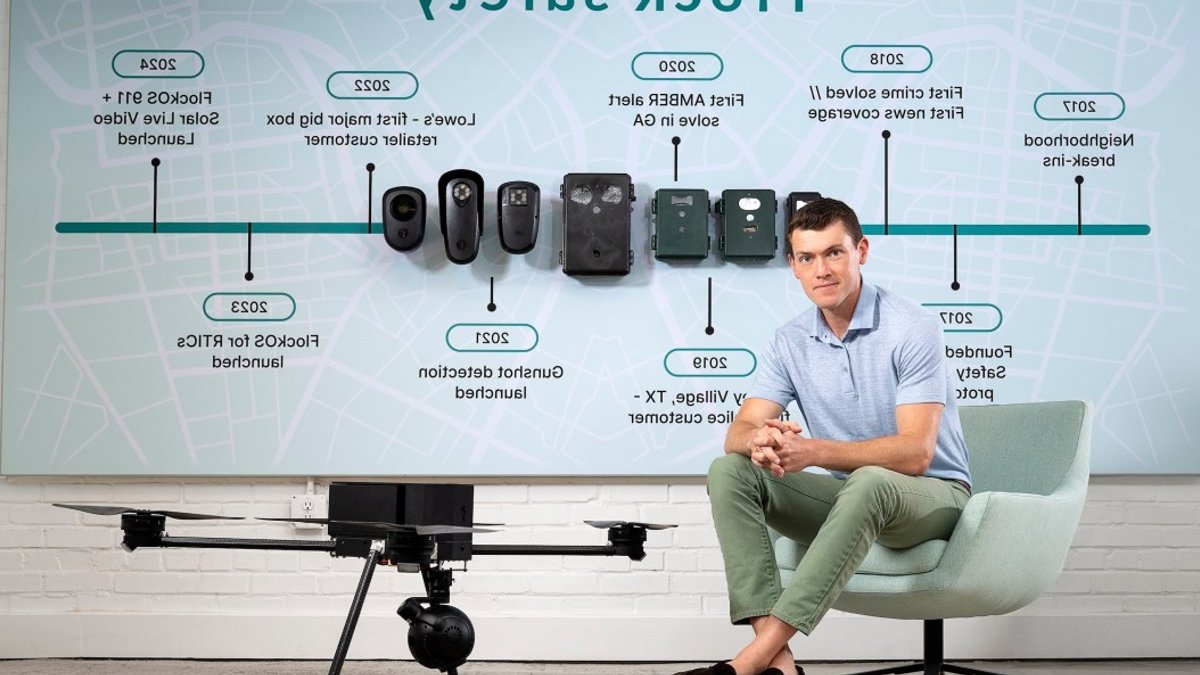
Flock Safety operates a network of automated license plate readers used by thousands of law enforcement agencies. The company maintains its technology does not violate the Fourth Amendment. CEO Garrett Langley described the constitutional question as straightforward, citing court rulings that support the system’s legality.
Constitutionality and Legal Interpretation
Langley recently addressed concerns about the system’s constitutionality. He stated that legal interpretation should be left to judges and elected officials, not individuals. “We follow the law, we follow the Constitution,” he said.
He referenced court decisions upholding ALPR use. “So far, in our belief and what will be for a long time, the courts have deemed this is not a warrantless search; this is a valid product as it relates to the Fourth Amendment,” Langley said.
The company’s position rests on the argument that license plates captured in public spaces do not carry the same privacy protections as personal communications.
Privacy and Data Retention
Langley presented Flock’s data retention policies as an improvement over past practices. He noted that before Flock, ALPR data was often stored indefinitely and sold commercially. The company now defaults to a 30-day retention period and prohibits data sales.
Related: Toyota’s GRMN Corolla hits record price for hot hatch
“We were one of the first to set a 30-day default retention and refuse to sell the data,” he said. He also cautioned that shorter retention periods could reduce effectiveness. “If I told you that if we reduce the 30-day retention to 14 days, 30% fewer crimes would be solved—so roughly 300,000 more victims without justice—would you make that tradeoff?”
The claim about crime-solving rates was not independently verified.
Langley believes local governments should decide how to use the technology. “You and I shouldn’t pick. Actually, the Mayor of Plymouth and the City Council should make that decision, because that’s a fair tradeoff. We elect people who we believe match our values to make these very difficult, non-black-and-white questions.”
Cities can tailor Flock’s system to their needs. Some limit its use to specific alerts, like Amber Alerts, without retaining data. Langley acknowledged this approach reduces effectiveness but still improves safety. “You could go down with something like Flock and say, ‘We like the idea of Flock, but we only want to focus on Amber Alerts and Silver Alerts.’ So there’s zero retention of the data, just alerts. I’d say, ‘Okay, you’re going to get about 50% of the value of the system, but if that’s what you want in Plymouth, great, we’d love to help you, but you’re still going to be safer.’ Now, you’re going to be less safe than San Francisco, but that’s an option,” Langley said.
The Debate Ahead
Errors in the system have drawn attention. The interviewer described being tracked for days, leading to a police stop involving four officers. The incident was later confirmed as a mistake, one of many that occur monthly as police rely on automated alerts.
Related: Subaru Forms Team to Enhance Driving Experience
Langley stressed that Flock does not dictate how its technology is used. “For us, we don’t want to push our opinion as individual citizens. I live in Atlanta, you live in Plymouth. We just wish that more elected officials would do their research, do their homework, form an opinion, engage the community, and then set a standard that makes sense for them.”
Without uniform standards, practices vary widely. The lack of federal rules forces communities to weigh safety and privacy without clear guidance—often with minimal public input.
The debate will continue as Flock expands. Tensions between its legal arguments and growing surveillance concerns show no signs of easing.
Used Porsche 911 prices have fallen this year, reflecting broader shifts in the luxury car market.


