
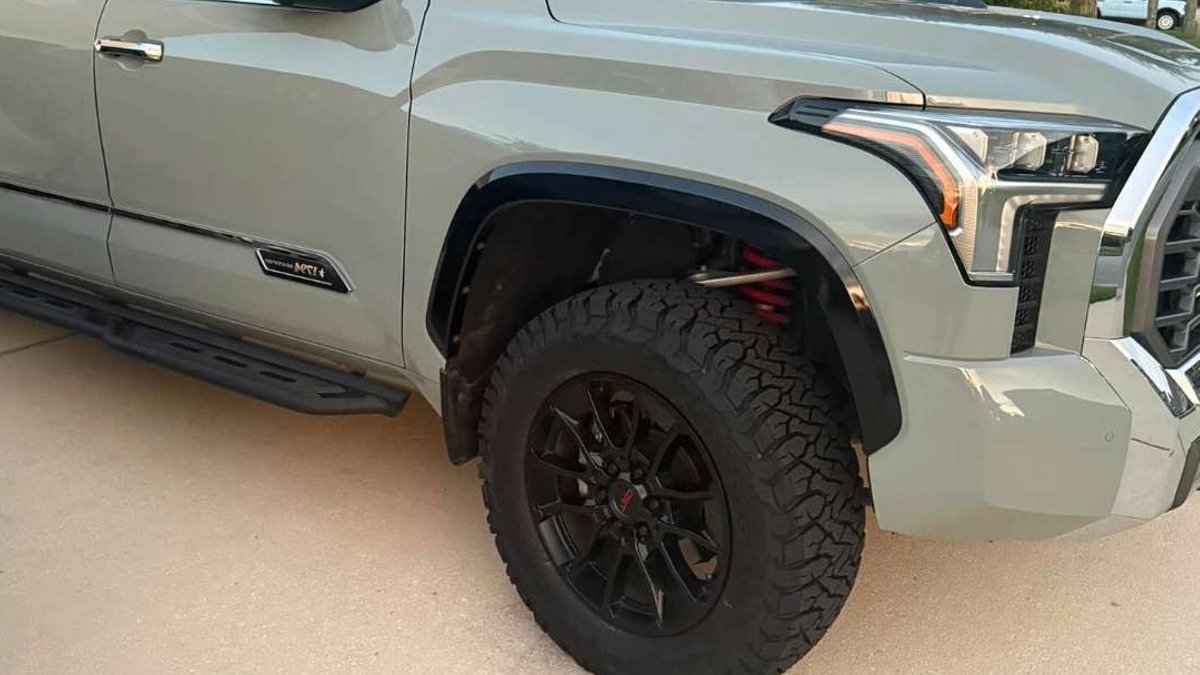
Toyota warns that skipping zero point calibration after a wheel alignment can cause safety system malfunctions. If a Tundra shows “Braking Power Low” with a spongy brake pedal after any service, owners should stop driving and have it inspected. These warnings matter to every Tundra owner before their next tire or alignment job. A 2023 to 2027 Tundra 1794 Edition owner recently experienced exactly this issue after visiting a local Firestone for new tires and an alignment.
What the Owner Reported
Vlado Vladimirov shared his experience in a Facebook group for 2023 to 2027 Tundra owners. He picked up the truck, but dash messages began appearing immediately. The brake pedal also felt soft and spongy. Vladimirov left the vehicle at the shop, promising they would fix it the next day.
Photos show the truck with 24,596 miles on the odometer. The dash displays five warnings: “Braking Power Low,” a Pre Collision System malfunction, a Parking Support Brake malfunction, a Check Engine message, and a red brake light. The owner asked the group if anyone had dealt with similar issues after tire or alignment work.
Neither the owner nor Firestone has publicly confirmed the cause of the warnings. Firestone has promised to repair the vehicle.
Toyota’s Guidance on the Warning
Toyota treats the “Braking Power Low” message as urgent. According to the owner’s manual language published for the Toyota C-HR, this warning may indicate a malfunction. Drivers should stop immediately in a safe place, contact a Toyota dealer, and avoid continuing to drive.
Earlier reporting on a Toyota Sequoia showing the same message explained that the brakes combine mechanical and electrical components. Any low braking power warning is a reason to stop as soon as possible. Vladimirov followed this advice by not driving the truck away.
Calibration Requirements After Alignment
Toyota’s own Collision Pro publication on zero point calibration states that modern Toyota and Lexus vehicles require calibration. Zero point calibration is necessary whenever a repair involves a wheel alignment. The publication warns that ignoring these steps has the potential to cause safety system malfunctions.
A technical guide on post-repair calibration requirements explains how these sensors work together. The stability control system uses the steering angle sensor along with a yaw rate and acceleration sensor. Both must be calibrated after an alignment to function correctly.
Firestone’s website recognizes this requirement on its safety systems alignment page. The page explains that the steering angle sensor monitors the vehicle’s straight-ahead position and is tied to stability control or electronic power steering. It lists Toyota among the brands that may require ADAS recalibration as part of an alignment.
The same page notes that a Firestone wheel alignment includes a test drive to ensure all systems are working properly. Firestone’s alignment packages page mentions that an additional charge may apply to vehicles with stability control or ADAS. Standard alignments carry a 12-month, 12,000-mile warranty, and technicians road test the vehicle to confirm the job is complete.
Owners in the Facebook group immediately pointed to calibration as the likely cause. Tyler Bettinger wrote that the steering angle sensor calibration wasn’t done, while John Addison Hewlett suggested that the issue could be finding zero again or taking the truck to a dealer for a relearn. Xaviar Bisin offered a different theory, suggesting the brake lines may have air or a leak and weren’t bled properly. These are theories from owners, not a diagnosis.
How to Avoid This Situation
Toyota dealers offer calibration as a service. Owners who value their safety may prefer to take their Tundra to a dealership for work. This ensures the specific procedures for their vehicle are followed. Independent shops like Firestone can perform the service but must have the correct equipment.
Technical Details on the Sensors
Zero point calibration sets the sensors to a known position. The steering angle sensor measures the angle of the steering wheel. The yaw rate sensor detects side-to-side movement. The acceleration sensor measures forward and backward forces. These parts work together for stability control. If the steering wheel is turned during calibration, the data becomes inaccurate.
Questions to Ask Before Getting Tires or Alignment
Owners should ask if the shop performs this calibration and how it is done. It is wise to get the price up front.


