
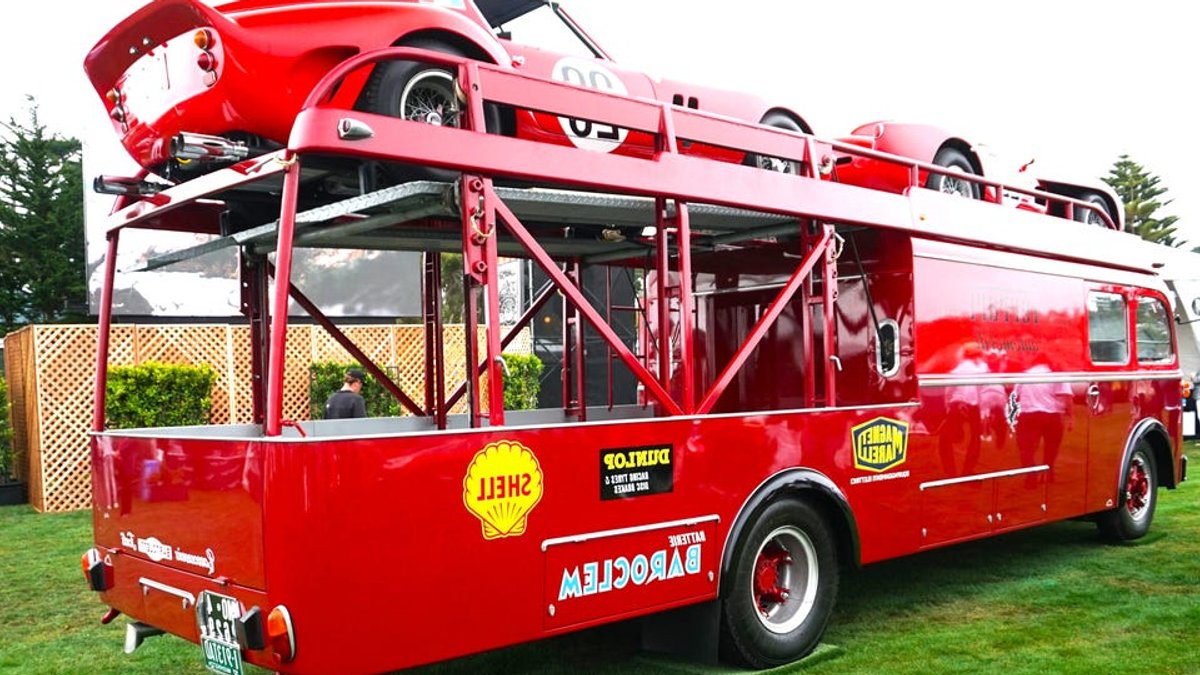
The 1957 Fiat Tipo 642 R transporter built by Carrozzeria Bartoletti drew attention at this year’s Pebble Beach Concours d’Elegance. The vehicle was originally designed to transport Ferrari’s race cars across Europe, carrying two on its roof and one underneath. It served the Scuderia for nearly ten years before being used to deliver road cars to customers.
After Ferrari retired the hauler in 1965, its role changed. A farmer bought it, converted the cab into a flatbed for hay, and later used its engine to pump irrigation water. Left abandoned in a field, the truck might have disappeared if not for its rediscovery in the 1990s. Bartoletti, the original coachbuilder, restored it, even bringing retired workers back to help.
Ferrari collector Jon Shirley found the transporter at Florida’s Cavallino Classic and purchased it immediately. Shirley, a two-time Best of Show winner at Pebble Beach, has a history of identifying rare automotive treasures—his 1938 Alfa Romeo 8C 2900B Touring Berlinetta and 1954 Ferrari 375 MM Scaglietti Coupé both earned top honors in previous years.
The truck regained attention last week during The Tour, a rally preceding the Concours. While most entries were sleek, high-value grand tourers and Depression-era luxury sedans, the Bartoletti transporter stood out. Its practical design contrasted sharply with the polished exotics around it.
One journalist experienced the event firsthand. Invited to ride as a passenger and “riding mechanic,” they joined a crew of five in the cab, including Shirley’s team. The group worked smoothly together, sharing jokes and stories as the truck moved through Monterey’s rain-soaked roads.
Related: Carlos Sainz Signs Multi-Year Deal with Williams
Driver Vinay, who had rebuilt the brakes for the event, handled the truck carefully. The hauler’s dual transmissions—one at the engine, another at the rear differential—required precise coordination, especially without synchromesh. Fred Russell, a curator for Shirley’s collection, explained that a complete mechanical overhaul had been done. “We were concerned about the brakes, so we replaced everything—new lines, the works,” he said.
The only issue occurred when the engine brake stuck, and the journey resumed. The crew waved to crowds as the transporter passed, drawing smiles and cellphone videos at every stop.
By the time the truck returned to the Equestrian Center, the day had already become memorable.
The transporter’s story—from Ferrari’s race team to a farmer’s field, then back to prominence—shows how automotive history often survives by luck. Restored not just to function but to its original role, it carried more than cars at Pebble Beach. It represented an earlier time, when mechanics traveled with their machines and a truck could outshine the vehicles it was built to transport.
The ride was brief. The next day, the journalist drove back to Los Angeles in a Volvo, the sound of the Fiat’s engine still fresh in their mind.


