
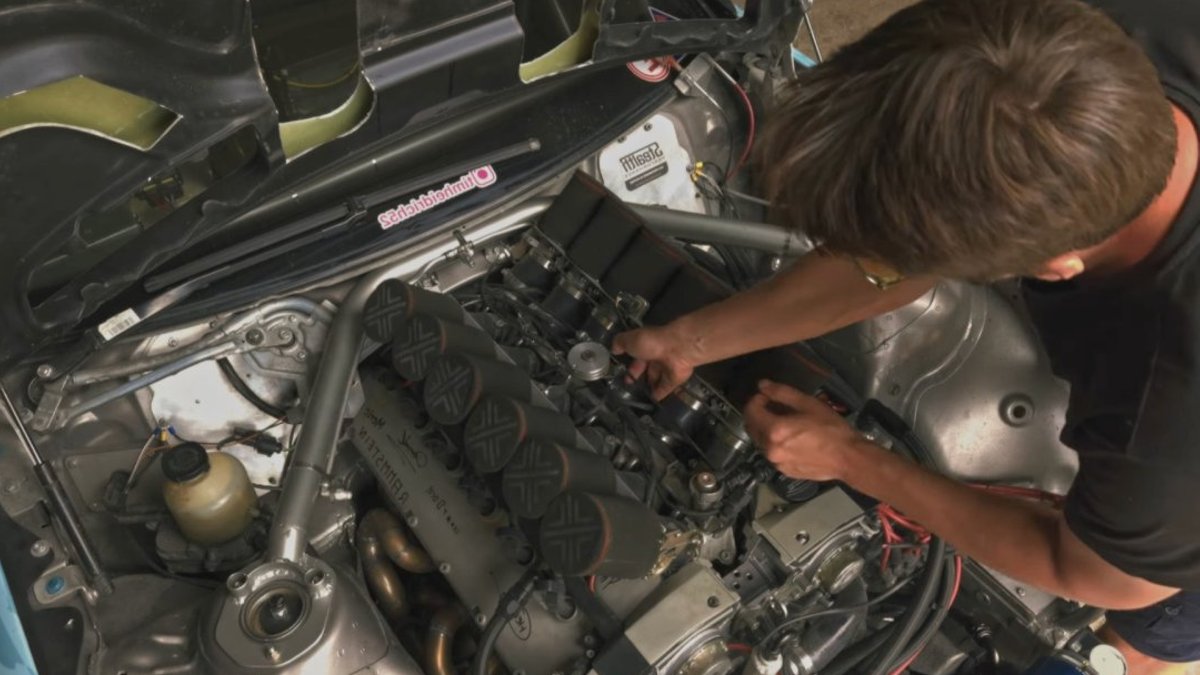
Ever wondered what a V11 engine sounds like? It’s a question that doesn’t have a straightforward answer because the configuration is physically impossible. A V-shaped engine requires an even number of cylinders to have the same amount of pistons on each side of the “V.” However, you can simulate the noise of an odd-numbered engine by deactivating cylinders on a larger V12 powerplant. Maisteer, a YouTube channel known for exhaust-sound experiments, recently tested this concept by modifying a Mercedes-Benz SL with a 6.0-liter V12.
The channel ran the modified R230 SL with a non-stock exhaust system to achieve the desired effect. By deactivating specific cylinders, the group simulated a V11 and a V9. The simulation involved pulling the spark plugs on cylinders 10 and 6, respectively. The setup created a sound that, to the listener, didn’t deviate drastically from a standard V12. The Mercedes SL shrieked like a race car, and the 11-cylinder arrangement produced a symphony that sounded largely identical to the correct version.
The file readouts show a definite change at 400 Hertz and 800 Hz frequencies, proving the sound is altered even if the human ear misses it. The V11 configuration actually sounds pretty good, which aligns with previous simulations done by other creators. In those tests, an inline-11 engine was also found to have a pleasant tone. Theoretically, an odd-numbered V-engine could work, but it would be too long to fit in a standard car.
Related: Police disguise nets phone using drivers
Engine sounds define the character of a vehicle. As the industry moves away from internal combustion, Hyundai, Bentley, and BMW are all experimenting with artificial sound generation for their EVs.
The V8 Rumble
After the V11 test, the group turned the engine into a V10 by deactivating cylinder 10. They then further reduced the count to a V9 by deactivating cylinder 6. The results were more noticeable this time. As cylinders were removed, the engine lost high-end frequency range and picked up more bass. The exhaust sound shifted from a shriek to a rumble as the configuration approached a V8.
When the V12 was down four cylinders, the sound dropped into that familiar V8 rumble. This progression highlights the importance of the number of cylinders in an engine’s acoustic profile. The odd-numbered configurations like V11 and V9 didn’t sound as different as one might expect, but the loss of cylinders significantly changed the overall timbre.
Related: Rare Cadillac CTSV race car up for sale
The simulated V11 engine is a fascinating experiment that demonstrates the flexibility of modern engine management systems. It shows that even an impossible engine configuration can produce a desirable sound profile, even if the physical implementation would be impractical for a production vehicle.
Automakers are currently exploring ways to replicate these auditory signatures in electric vehicles to maintain the driving experience.


